
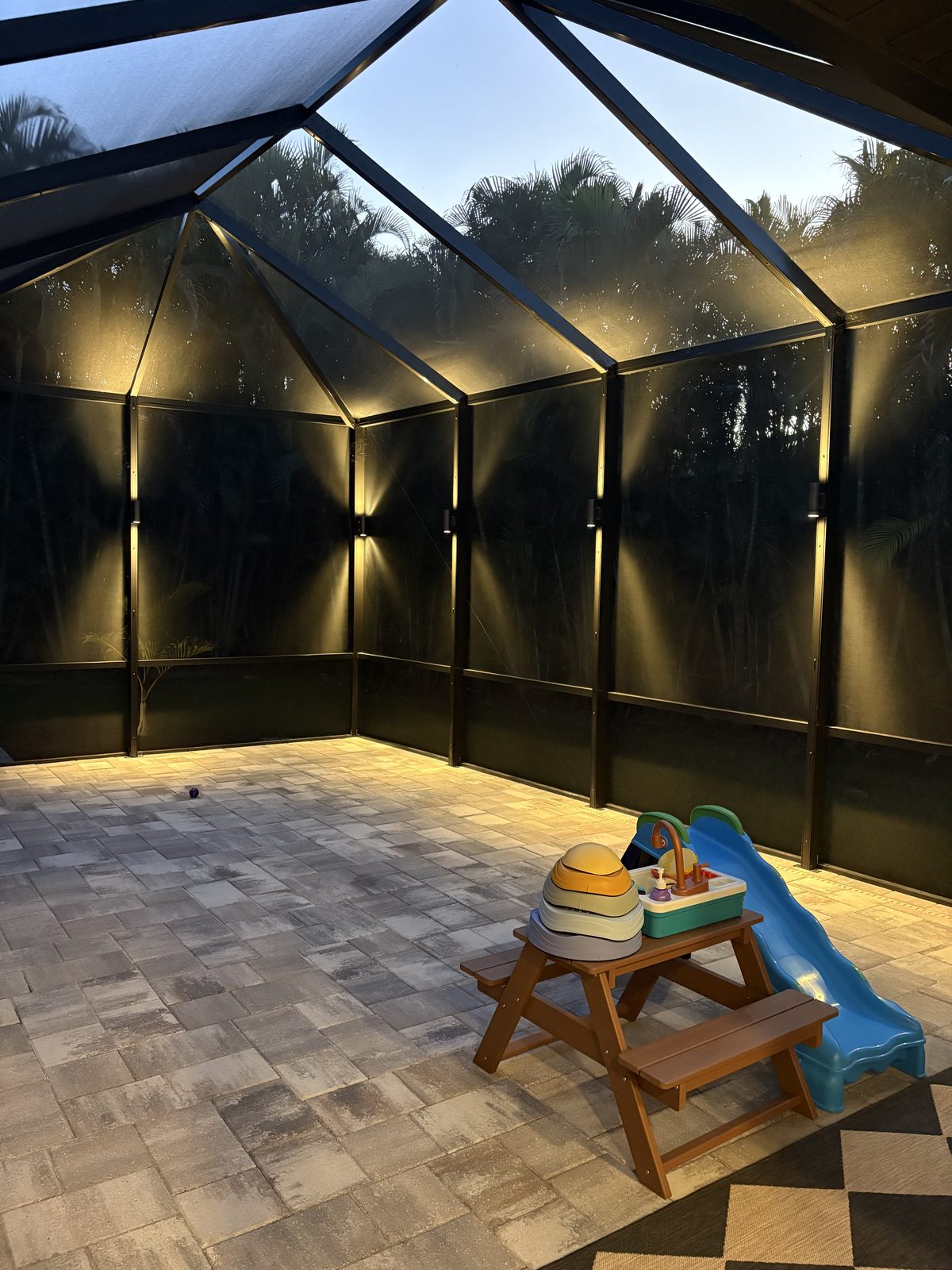
A good Tampa lighting walkthrough should design around the property, not just count fixtures.
By LogiBuilt · August 25, 2026 · 7 min read
When we walk a Tampa property for landscape lighting, we are not just counting fixtures. We are looking at how the home is used after dark, how the yard drains after a storm, how the lanai and pool cage affect sightlines, and where wire can be run cleanly. A quote that skips that work may look simple, but the finished system often feels scattered. Good lighting starts with judgment on site.
This matters especially on homes with a lanai, pool cage, beds, trees, and walkways. Those areas all behave differently in Florida heat, humidity, sandy soil, and afternoon storms. A walkway needs safe, comfortable direction, while a palm or oak needs a different approach entirely. The walkthrough should prove the installer is designing the property, not filling a fixture count.
The first thing we want to understand is where people move, gather, and look from at night. A front walkway, side gate, pool deck, and lanai seating area all serve different purposes. Lighting should support those habits instead of turning every bed into the same bright strip. If the installer does not ask how you use the space, they are missing the point of the walkthrough.
In Tampa, the lanai often becomes the main evening room of the house. Many homeowners look outward from under cover toward the pool cage, beds, palms, and back fence. That view needs to be considered from inside the lanai, not just from the grass looking back at the home. We like to stand where you sit, because that is where glare and dark gaps become obvious.
Pool cages deserve special attention because they change how outdoor lighting feels. They are common in Florida because they help homeowners use outdoor space with fewer insects, falling leaves, and debris. They also create structure, shadows, and reflections that can affect fixture placement. A good walkthrough looks at the cage as part of the scene, not as something to ignore.
Tampa landscapes change quickly, especially with palms, oaks, hedges, and tropical plantings. A fixture that looks clear today can be swallowed by growth if placement is careless. We look at trunks, canopies, root zones, mulch beds, and expected maintenance patterns. The goal is lighting that still makes sense after trimming, growth, and seasonal cleanup.
Oaks need a different eye than palms. An oak can create broad shade, layered branches, and heavy leaf drop around the fixture area. A palm may call for cleaner vertical emphasis, but the fronds still move and shed. The walkthrough should notice the character of each tree before deciding how to light it.
Beds are not all equal either. Some are shallow foundation beds with short runs and easy access. Others curve around pools, screen enclosures, pavers, or drainage areas. Sandy soil can make placement easy in one spot and unstable in another. We check where fixtures can sit securely without being in the way of edging, lawn crews, or foot traffic.
Fixture count matters, but wiring often determines whether the system will be clean and reliable. Homeowners are wise to ask how the contractor plans for wiring, because a beautiful design still needs a practical path. We look for routes that avoid obvious trip points, poor burial areas, and places where future service would be difficult. A walkthrough should make the wire plan visible in plain language.
Access is a major part of that discussion. Pavers, pool decks, driveways, mature roots, and tight side yards can all affect how wire runs are planned. Some areas are easy to reach, while others require more careful routing around finished surfaces. The right quote should reflect those conditions instead of pretending every yard is the same.
Transformer placement also needs to be discussed on site, without turning the meeting into a technical lecture. We look for a sensible location that supports the planned zones and keeps the system serviceable. The location has to work with the property, the power source, and the way the lighting will be controlled. If that conversation never happens, the quote is missing an important piece.
Not every fixture belongs on a ground stake. Landscape lighting can be mounted in different ways depending on location and surface, including ground stakes, surface mounts, gutter mounts, and specialized mounting hardware. The correct choice depends on what is being lit and what the fixture has to attach to. During the walkthrough, the installer should point out where standard placement works and where it does not.
This comes up often around lanais, pool cages, hardscape edges, and architectural details. A bed may accept a ground stake cleanly, while a paved area may require a different mounting approach. A gutter or structure may create an option in one spot and a bad idea in another. The walkthrough should separate those decisions instead of treating every fixture like it lives in mulch.
Mounting also affects maintenance. Fixtures near mower paths, hedge trimming, and pool service routes need to be placed with real life in mind. We look for spots that protect the fixture while still getting the beam where it needs to go. A system that is hard to live with will not feel well designed, even if it looks good the first night.
Homeowners should ask what types of fixtures and materials the contractor uses. That is not about chasing a brand name during the walkthrough. It is about understanding whether the components fit the conditions on the property. Tampa humidity, rain, heat, and salt air near the coast make material choices and installation details matter.
We pay close attention to low areas that hold water after afternoon storms. We also look at downspouts, irrigation spray, pool splash zones, and places where mulch builds up against fixtures. None of those details are dramatic, but they affect how the system ages. A careful installer notices them before the quote is written.
Serviceability matters too. Fixtures should not be placed where every adjustment requires disturbing a plant bed or fighting through a tight corner. Wiring routes should make sense if troubleshooting is ever needed. We warranty our work for one year, and we prefer installing systems that can be maintained cleanly long after the first night.
By the end of the walkthrough, you should understand the basic design logic. That does not mean you need to know every technical detail. You should know which areas are being lit for safety, which are being lit for depth, and which are being left darker on purpose. Darkness is part of good lighting, especially around pools and lanais where glare can ruin the view.
A professional landscape lighting designer thinks in layers, sightlines, and use. A strict installer may be able to place fixtures, but the homeowner should ask whether design is part of the service. The difference shows up in how the property is evaluated before the quote. We believe the walkthrough is where that difference becomes clear.
The quote should connect back to what was observed on site. Fixture count, wire runs, transformer sizing, mounting needs, access, and zones all drive the scope. If the home has mature trees, a pool cage, curved beds, and long walkways, those details should be reflected in the plan. A good proposal should feel like it belongs to your property, not any property.
If you are comparing landscape lighting options for your Tampa home, we would be glad to take a look in person. Book a free in-person walkthrough, and we will help you understand what your property needs before you decide.
A daytime walkthrough is useful for seeing wiring paths, mounting surfaces, trees, beds, irrigation, and access. If there are existing lights or specific glare concerns, it also helps to talk through what you notice at night.
Ask whether the contractor is designing the lighting or only installing fixtures. You should also ask what fixture materials they use, how they plan wiring, and how they will handle mounting on different surfaces.
A pool cage affects sightlines, shadows, and reflections from the lanai and pool area. Since Florida homeowners often use cages to reduce insects, leaves, and debris, the lighting plan should treat the cage as part of the outdoor room.
The main drivers are fixture count, wire run length, transformer sizing, number of zones, mounting conditions, finished surfaces, access difficulty, and how many separate areas need to be lit.
Try our free lighting visualizer, see your home transformed in about a minute. No upload needed.
Free consultation, honest quote. Most estimates come back within one business day.
or call (813) 696-3168