
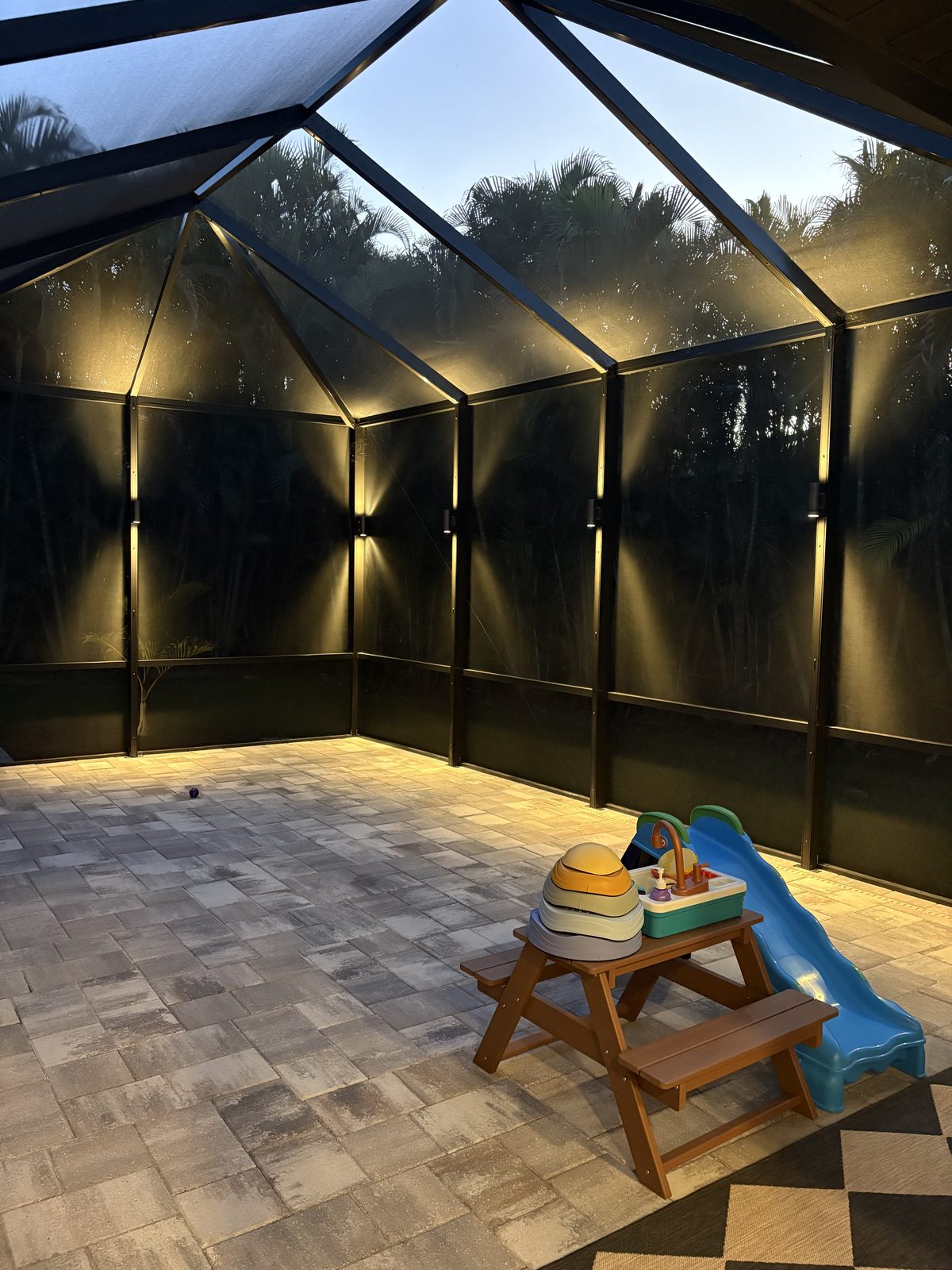
Florida yards demand landscape lighting designed around heat, humidity, storms, salt air, drainage, and the way Tampa homes are actually used.
By LogiBuilt · August 18, 2026 · 6 min read
Landscape lighting in Tampa Bay is not just a design choice. It is an outdoor system living in heat, humidity, irrigation overspray, sandy soil, salt air, and summer storms. A layout that looks good on the first evening still has to make sense after a wet August, a windy week, and regular yard maintenance. That is why we judge landscape lighting by how it performs over time, not just how it photographs on day one.
When we walk a property, we are looking at more than where a fixture can shine. We look at drainage, plant growth, lawn equipment paths, pool cages, lanais, palms, oaks, walkways, and how the homeowner actually moves through the yard. Florida focused lighting products, including Sunset Sconce lights and Lanai Lights systems, are marketed around this climate because our conditions are not mild or occasional. The better question for a homeowner is whether the whole installation has been planned for those conditions, from placement to access to serviceability.
Florida humidity is constant enough that we treat it as a design condition, not a rare problem. Outdoor lighting needs to live through warm nights, wet mornings, sprinkler cycles, and afternoon storms. That means we pay attention to where water naturally collects and where air circulation is poor. A shaded bed under thick oak canopy behaves differently than an open palm border near a driveway.
Salt air is another Tampa Bay reality, especially near the water or in neighborhoods that catch steady coastal breezes. Even when a home is not directly on the beach, the environment can still be hard on outdoor finishes and connections. Sunset Sconce lights are described by their maker as designed to handle Florida humidity, UV rays, and salty sea breezes. That kind of climate awareness matters because a fixture is only useful if it keeps doing its job after exposure becomes routine.
Hurricane season also affects how we think about landscape lighting, but not in a dramatic way. We do not promise that any outdoor system is storm proof. We focus on sensible placement, clean routing, and avoiding choices that create unnecessary weak points. A good installation should feel like part of the property, not like loose hardware scattered through the beds.
The most common stress on Tampa landscape lighting is not one single storm. It is repeated moisture from humidity, rain, irrigation, wet mulch, and soil that stays damp longer than expected. That is why the small details matter more than many homeowners realize. A system can look neat at first and still be poorly prepared for the way water moves through the yard.
On a walkthrough, we look for irrigation heads before we talk about fixture locations. We want to know where sprinklers spray, where gutters discharge, and where downspouts push water during a hard rain. Pool equipment areas, side yards, and low spots along lanais often tell us a lot about the property. If the lighting plan ignores those areas, the homeowner may end up with service issues that could have been avoided.
Sandy soil creates its own set of decisions. It can shift around fixtures, especially near beds that get reworked or edges that are maintained often. Heavy roots from oaks and palms can also limit where clean wire runs make sense. We would rather adjust the design on the front end than force a layout that fights the yard every season.
Florida outdoor living is different from a lot of other places. Many Tampa homes use lanais, pool cages, side gates, outdoor kitchens, and rear walkways almost every evening. Landscape lighting should support those patterns without making the yard feel harsh or overlit. The goal is comfort, visibility, and depth, not simply putting a light on every plant.
We pay close attention to transitions. A step from a lanai to a pool deck, a path from the driveway to a side gate, or a dark corner near a trash area may matter more than a dramatic accent on a palm. Good lighting makes those areas easier to use without calling attention to itself. If guests can move naturally and the yard still feels calm, the design is doing its job.
Lanai Lights describes its outdoor lighting systems as designed for Florida climate and for making outdoor spaces usable year round. That is the right lens for Tampa homes because many families use the outside of the house as living space, not as decoration. A lighting plan should respect sightlines from inside the home as much as views from the yard. What looks balanced from the patio doors often matters more than what looks bright from the street.
Homeowners often ask what landscape lighting should cost, and we understand why. The honest answer is that the drivers matter more than a quick number. Fixture count, length of wire runs, transformer sizing, surface and access difficulty, and how many zones all affect the scope. A small front entry can be a very different project from a full yard with pool area, side access, and layered planting beds.
Access is a major factor in Tampa properties. Some yards are open and easy to route cleanly, while others have mature landscaping, tight side yards, pavers, pool cages, or heavy root systems. Those conditions do not make the project bad, but they do change the planning. A careful walkthrough lets us see what the yard will actually allow instead of guessing from photos.
Zones are another practical decision. A homeowner may want the front elevation, rear lanai area, and path lighting controlled in different ways. That can make the system more useful, especially when the family uses different parts of the property at different times. The right number of zones should match daily life, not add complexity for its own sake.
A good landscape lighting walkthrough should feel thorough. We want to see the property in context, not just count potential fixture locations. We ask how the family uses the yard, where it feels too dark, and which views they care about most. We also look for maintenance realities, because landscapers, mulch refreshes, and plant growth will interact with the system.
We study the architecture and the planting together. A tall palm, a low hedge, a textured wall, and a shaded oak canopy all respond differently to light. We also consider glare, especially near lanais, bedroom windows, and seating areas. If lighting makes the homeowner squint or see bright points instead of the yard, the design needs work.
We also think about service from the beginning. Outdoor systems should be accessible enough to maintain without tearing up the yard. That matters in Florida because plants grow quickly and beds change over time. Work that lasts is usually work that was planned with future access in mind.
If you are comparing installers, ask what they noticed during the walkthrough. A strong answer should mention drainage, irrigation, plant growth, access, controls, and how the lighting will look from the places you actually sit or walk. It should also include a clear explanation of what drives the scope, not a rushed guess. The person designing the system should be able to explain tradeoffs in plain language.
LogiBuilt offers a free in person walkthrough for Tampa Bay homeowners considering landscape lighting. If you want lighting planned around Florida weather and your actual property, we would be glad to take a look.
Yes, but the whole installation has to be planned for the environment. We look at drainage, irrigation spray, shade, soil conditions, and access because humidity and moisture are part of daily life here.
It can. Many Tampa Bay homes still experience salty breezes and harsh outdoor exposure, so fixture selection and placement should account for more than just the property line.
The main drivers are fixture count, wire run length, transformer sizing, surface and access difficulty, and how many lighting zones the homeowner wants.
Yes. In Florida, those areas often function as living spaces, so the lighting should support how you move, sit, entertain, and view the yard from inside the home.
Try our free lighting visualizer, see your home transformed in about a minute. No upload needed.
Free consultation, honest quote. Most estimates come back within one business day.
or call (813) 696-3168