
Tampa Bay homeowners learn the same lesson every few years: when a real storm is hours out, the technology you wish you had installed is the technology you can no longer install. The contractors are fully booked. Big-box shelves are empty. The lead time on a small backup battery is suddenly six weeks. The window to harden your home is the months before, not the week of.
This guide is the short, practical list of home-tech upgrades that meaningfully change how a Tampa house weathers a hurricane and how quickly you recover after one. Some of it you can do this weekend. Some of it is a real install we'd handle for you. None of it requires you to buy a generator the size of a refrigerator.
TL;DR, What to check before June 1
- Surge protection on the panel, whole-home surge plus point-of-use on every TV, A/V receiver, network rack, and smart-home hub.
- Backup power for what matters, small UPS battery on the network rack and one camera NVR. 4–8 hours of runtime is plenty for most storms.
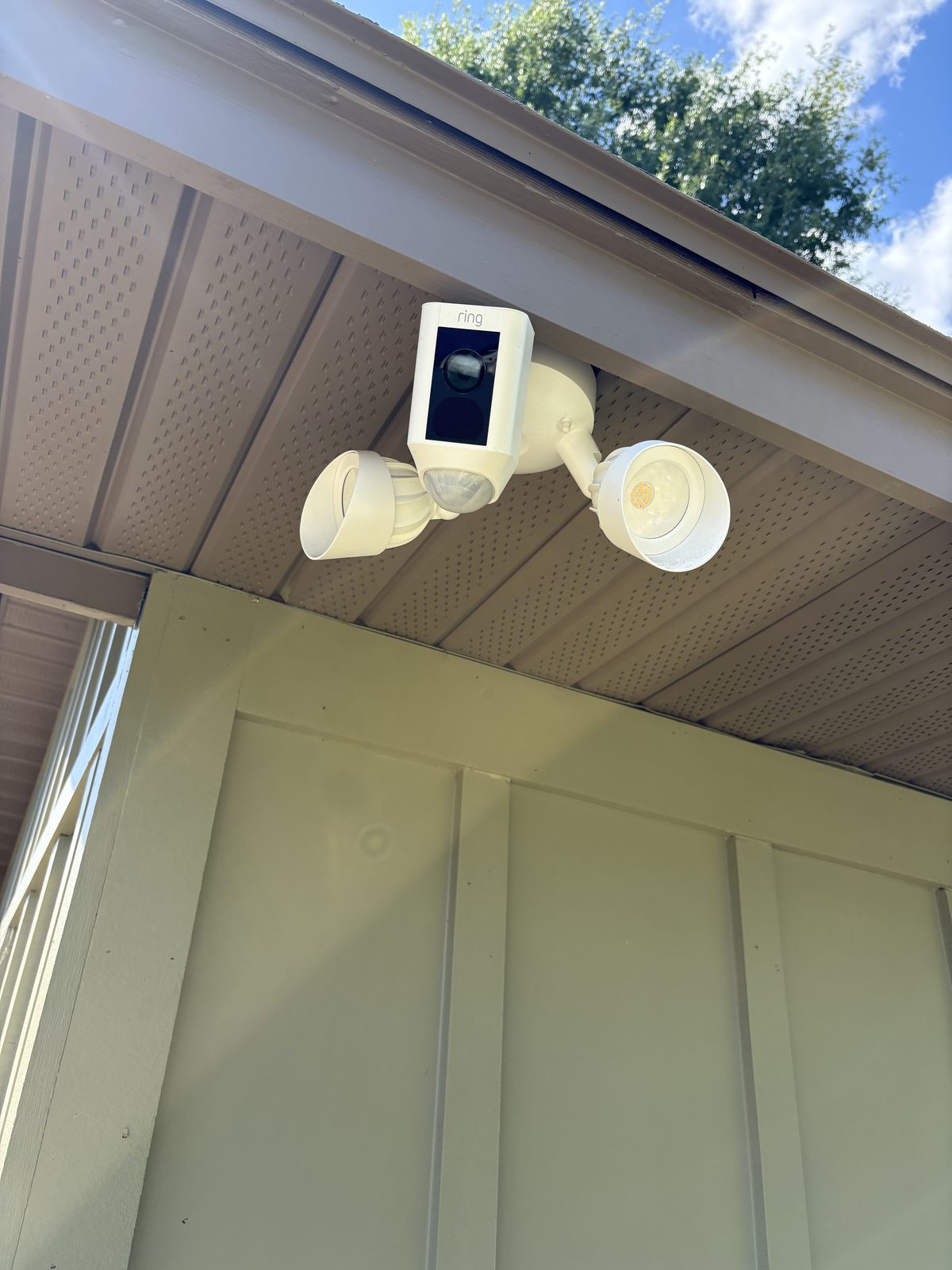
- Remote-viewable cameras, at least one PoE camera per side of the house, all confirmed working in the app, and a backup viewing path that doesn't depend on Wi-Fi at home.
- Smart locks + smart garage, let neighbors or family check on the house without driving over.
- Cellular failover, a tiny LTE backup so your alarm and at least one camera keep reporting if the cable line goes down.
If you can only do three: surge, backup network power, and at least one always-on camera with cellular fallback. That trio alone changes how much you know during the storm.
1. Surge protection is the first thing that fails (and the cheapest to fix)
Florida lightning is not theoretical. Pinellas and Hillsborough counties are in the most lightning-active corridor in the United States. A direct strike will take out almost anything; the much more common scenario is the surge that rides in on the line during a storm or after a transformer trip during restoration. That surge takes out the TV, the A/V receiver, the cable modem, the smart-home hub, and the doorbell power supply, usually all on the same circuit.
The fix is two layers, and both are worth it.
Whole-home surge protector at the panel
This is a small device installed in your main electrical panel by a licensed electrician. It clamps spikes on the incoming feed before they reach any individual circuit. Installed cost in Tampa is typically $400 to $700. It does not replace point-of-use protection but it is the foundation. We coordinate this with our electrical partners during smart-home installs that touch the panel anyway.
Point-of-use surge bars on every gear cluster
Every TV, every A/V rack, every network rack, every smart-home hub: real surge protectors with a high joule rating and an indicator light that tells you when they have absorbed a hit and need to be replaced. Cheap power strips do not count. A real surge bar is $40 to $90. After any major storm, walk the house and look at the indicator lights. Replace any that have dimmed or gone out.
2. Backup power for the small stuff that matters most
Most Tampa homeowners think about backup power at the generator scale: 14kW Generac, transfer switch, the works. That conversation is real, but it is also a $9,000 to $14,000 conversation, and it is not what we are talking about here.
The much smaller upgrade is putting your network, camera recorder, and alarm panel on small battery backups. This is what keeps you informed during the storm even when the lights are out.
Network rack UPS (450 to 1500 VA)
A 600VA battery backup is around $90. Plug your modem, router, and PoE switch into it. Once the lights go out, your network keeps running for 4 to 8 hours depending on load. Combined with cellular failover (next section), this means your cameras keep recording, your alarm keeps reporting, and you keep getting notifications on your phone even when the house is dark.
NVR battery backup
If you have a Network Video Recorder running PoE cameras (which is what we install), put it on its own UPS. Same logic: $90 to $150 for the battery, several hours of recording continuity, no gap in the footage that matters most when something is happening.
Smart-home hub backup
If you have a Lutron, Hubitat, or similar hub controlling lighting and shades, a small UPS keeps it online so the system doesn't have to re-discover devices when power comes back. This is the difference between flipping a breaker and being live again, vs. spending two hours the next day re-pairing scenes.
3. Cameras you can actually watch from the evacuation route
This is the biggest emotional gap. People install cameras and then never confirm the remote viewing actually works under realistic conditions. The first time you find out the app has been logged out for six months is the day you are sitting in a Cracker Barrel in Lake City, watching a hurricane chyron on the TV, with a dead phone app and a soaked phone in your hand.
Set up the right way
- One camera minimum per exposed side of the house. Front, sides, and rear. Most Tampa homes need 4 to 6 PoE cameras to cover what matters; some need more if there are detached structures.
- Verified remote viewing on whatever platform you're on (Reolink, Hikvision, Ubiquiti, etc.). Open the app from a cellular network with Wi-Fi turned off and confirm every camera streams.
- Pre-storm walk-through two weeks before peak season, a simple checklist where you tap each camera in the app, confirm the feed, and write down which app version you are on. We do this for our security clients in late May every year.
- Local storage, not just cloud. If the cable line goes down, cloud-only cameras stop recording. Local storage on an NVR survives. Cloud is a nice supplement; local is the foundation.
The cellular fallback path
The single best $20-per-month upgrade for a Tampa home is a cellular failover device on your network. When the cable internet goes down, the failover device automatically switches your network to LTE or 5G. Bandwidth is reduced, but it is enough to keep cameras reporting and alarm signals going through. Brands worth knowing about include Ubiquiti, Verizon, and several alarm-system-specific options. Installed cost is $200 to $500 plus a small monthly cellular plan.
4. Smart locks and smart garage doors so others can check on the house
If you evacuate to the Panhandle or to North Carolina to wait out a major storm, you may need someone, a neighbor, a family member, or a contractor, to physically enter the house. Either to check on it after the storm passes, or to start drying out a leak, or to retrieve something forgotten. Without a smart lock, this is a key-handoff problem. With a smart lock, it is one tap on your phone.
What we install
- Wi-Fi or matter-enabled smart locks on the front and side doors. We use Schlage Encode, Yale Assure, and similar pro-grade locks. Installed cost is $250 to $400 per lock.
- Time-bounded access codes for trusted contacts. Generate a four-digit code that works for 48 hours and expires automatically. The neighbor doesn't need a key, you don't need to drive home to take it back.
- Smart garage door controllers (myQ, Tailwind, etc.) on the opener. Same idea, remotely grant access, check whether the door is open or closed, get notified if it cycles. Installed cost: $150 to $250.
- Activity logs. Every entry shows up in the app with a timestamp and which code was used. After-the-fact forensics are simple.
5. Smart shut-off valves for the water nobody planned for
Hurricane wind is the headline. Water is the actual damage. After-storm flooding from a broken supply line, a hose bib that snapped, or a hot-water heater that took a hit during a power surge can do more dollar damage than the storm itself. The smartest Florida homeowners we work with install a smart water shut-off on the main supply line.
How it works: a powered valve sits on the main, monitored by a flow sensor. If the system detects continuous water flow when no one should be using water (you're evacuated, or it's 3 AM), it auto-shuts the valve. You can also remotely shut off the water from the app. Brands worth knowing: Moen Flo, Phyn, Flume Smart Valve. Installed cost: $1,200 to $2,200 depending on whether plumbing modifications are needed.
This is one of the few hurricane-prep items where the math is genuinely brutal: a $1,800 install can stop a $30,000 water-damage claim. Insurance companies are starting to give discounts for it.
6. Pre-storm checklist (the actual list we send our clients)
Two to three weeks before each named storm reaches Tampa Bay, we send our security clients this checklist. You do not need to be a client to use it.
72 hours before landfall
- Open the camera app on cellular (Wi-Fi off) and confirm every feed.
- Replace any surge protector with a dim or dead indicator light.
- Verify your smart locks have full battery (most show this in the app).
- Confirm at least one trusted contact has an active access code on the lock.
- Confirm the garage door controller is online and responsive.
- Test cellular failover by unplugging the cable modem briefly, cameras should keep streaming after a 30-second delay.
- Charge any portable USB battery banks for after-storm phone use.
- Set the smart-home hub to "away" or "vacation" mode if you're evacuating, lights run on schedule, system is alarm-armed, etc.
- Take a quick video walkthrough of every room. Free, takes 10 minutes, invaluable if you ever need to file a claim.
What this typically costs to do right (Tampa, 2026)
If you are starting from a typical Tampa home with no surge protection, no smart locks, and no security cameras, here is the realistic budget to get hurricane-ready:
Hurricane-ready home-tech budget (Tampa, 2026)
- Whole-home surge + 6 point-of-use surge bars: $700 to $1,200 installed
- 4-camera PoE security system with NVR + UPS backup: $2,800 to $4,500 installed
- Cellular failover for network: $300 installed plus $20–$40/mo
- Two smart locks + smart garage controller: $700 to $1,100 installed
- Smart water shut-off valve: $1,500 to $2,200 installed
- Network UPS + smart-hub UPS: $200 self-install or $350 installed
Total: $6,200 to $9,650 to fully harden a Tampa single-family home with current best-practice gear. Most of our clients do this in two phases, cameras and surge first, smart access and water shut-off later.
What we don't recommend (and why)
- Cloud-only doorbell as your only camera. They are great as one piece of a larger system, terrible as the only piece. If your internet drops, you have nothing.
- Cheap battery cameras. The batteries die exactly when you need the camera most. Wired PoE is the only correct answer for hurricane-ready monitoring.
- Generator-only thinking. Whole-home generators are great. They also cost ten times what the actual hurricane-tech upgrades cost. Do the small things first.
- Over-relying on one app. Most platforms require a Wi-Fi-only setup step that fails the day power is out. Cellular failover and good local storage are what keep you informed.
Two real Tampa Bay hurricane-prep installs
Example 1: Bayshore home, full hurricane hardening, $7,400
Whole-home surge at the panel, six PoE cameras around the perimeter, NVR with 4TB local storage and 1500VA UPS, cellular failover on the network rack, two Schlage Encode smart locks, smart garage controller. Owner evacuated for a Cat 2 in 2025 and watched the entire storm cycle from a hotel in Atlanta with zero gaps in camera footage. Said it was the first storm where she did not feel like she was guessing what was happening to the house.
Example 2: Apollo Beach waterfront, water-focused build, $4,200
Owner had cameras already. Added: whole-home surge, smart water shut-off valve on the main, two smart locks for contractor access, network UPS. After Helene-class storm surge in 2024, the auto shut-off triggered when the floor sensor detected water; the home did not lose pressure on a clean line and recovery was much faster than neighbors who came back to flooded interiors.
Get hurricane-ready before the season starts
If your home is not currently set up for any of this, the next 4 to 6 weeks is the right window. We are booking hurricane-prep walkthroughs across Tampa Bay through the end of May. We come out, look at what you have, and write a no-pressure quote that tells you what is worth doing now versus later.
Call or text (813) 696-3168 or use the contact form. Most prep walkthroughs are scheduled within the same week and the quote follows within one business day.
For the cameras and alarm side specifically, see security camera installation. For the surge, hub, and lock layer, see smart home setup. When you're ready, get a free site assessment and we'll come out before the season starts.